Victoria Falls is the world’s largest sheet of falling water.
The mighty Zambezi River flows through six countries and is the lifeblood of the bordering counties. The banks of Africa’s fourth-largest river touch many pristine wildlife areas along its journey.
Between Zimbabwe and Zambia the Zambezi River flows over the Victoria Falls cascading into the gorge below.
Locals call the Falls – Mosi-oa-Tunya, which means “the smoke that thunders”. There are many myths and legends surrounding the Falls.
Archaeologists have unearthed fossils and implements suggesting that early humans inhabited the vicinity of the falls approximately 3 million years ago.
The Batoka tribe ultimately supplanted these Stone Age inhabitants, subsequently joined by the Matebele and Makolo tribesmen. The indigenous natives harbored a profound terror of the falls.
The river god Nyami Nyami is closely connected to the Zambezi River and is sacred to the Tonga tribe. He is believed to
live under a large rock in Lake Kariba, which is located downriver from the Victoria Falls.
Nyami Nyami is a mix between a snake and a fish. It is believed that if you wear the Nyami Nyami pendant you will be protected as the god protects life in and on the river.

According to African mythology, Nyami Nyami has been in hiding since the Europeans arrived at the Victoria Falls. It is said that when the god appears, the water turns red.
The building of the Kariba dam angered Nyami Nyami because the dam wall separated him from his wife. Floods and earthquakes in the area are attributed to his wrath.
The Falls themselves have long been considered a mystical threshold. Mists rising from the gorge are believed to carry the voices of ancestors, and rainbows that dance above the water are seen as signs from the spirits.
Early tribal ceremonies often took place near the falls, with offerings made to the river to appease Nyami Nyami and ensure good rains, health, and peace.
Victoria Falls is classified as the largest waterfall in the world based on its combined width of 5,604 ft and height of 354 ft, resulting in the world’s largest sheet of falling water.
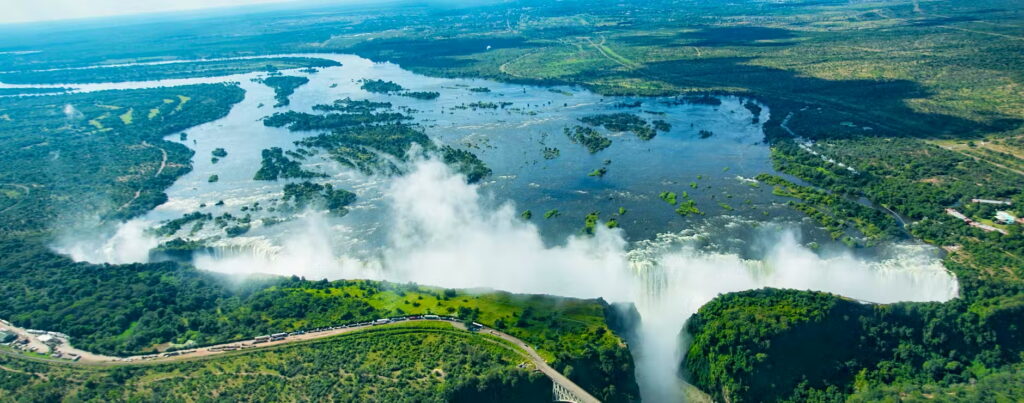
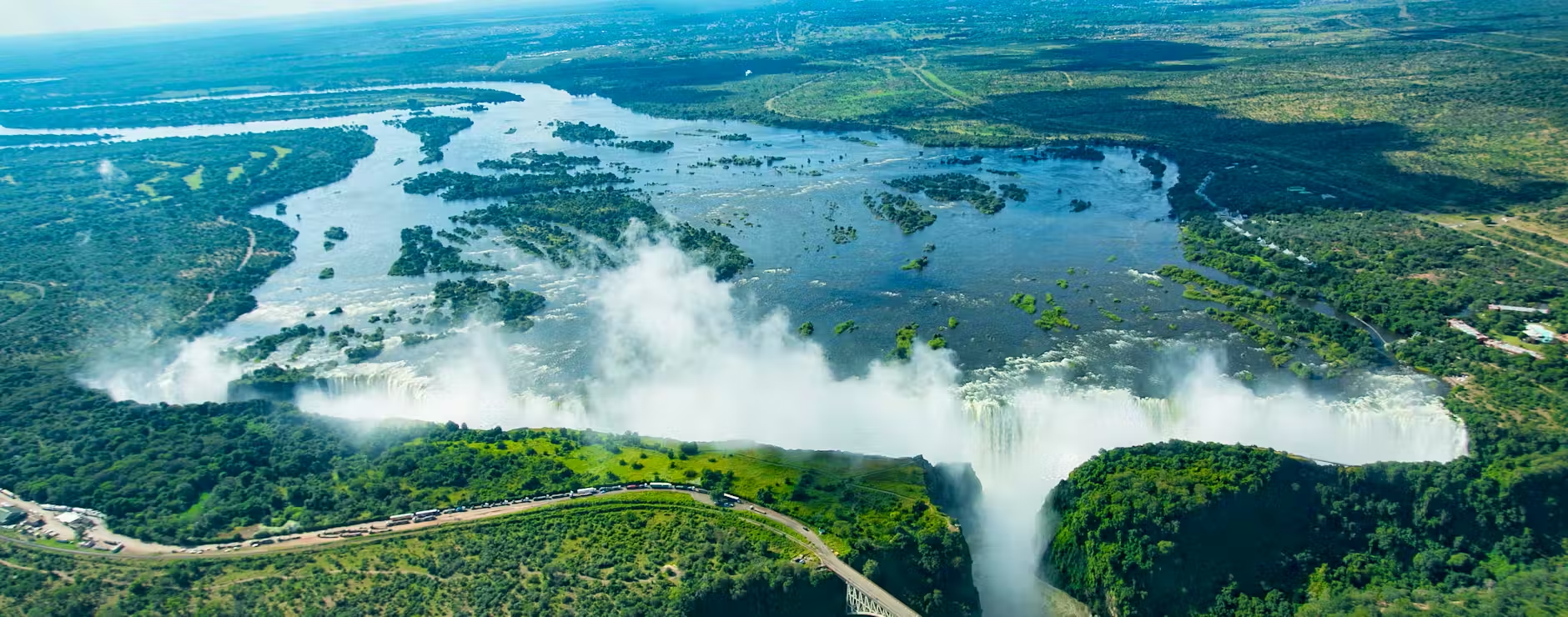
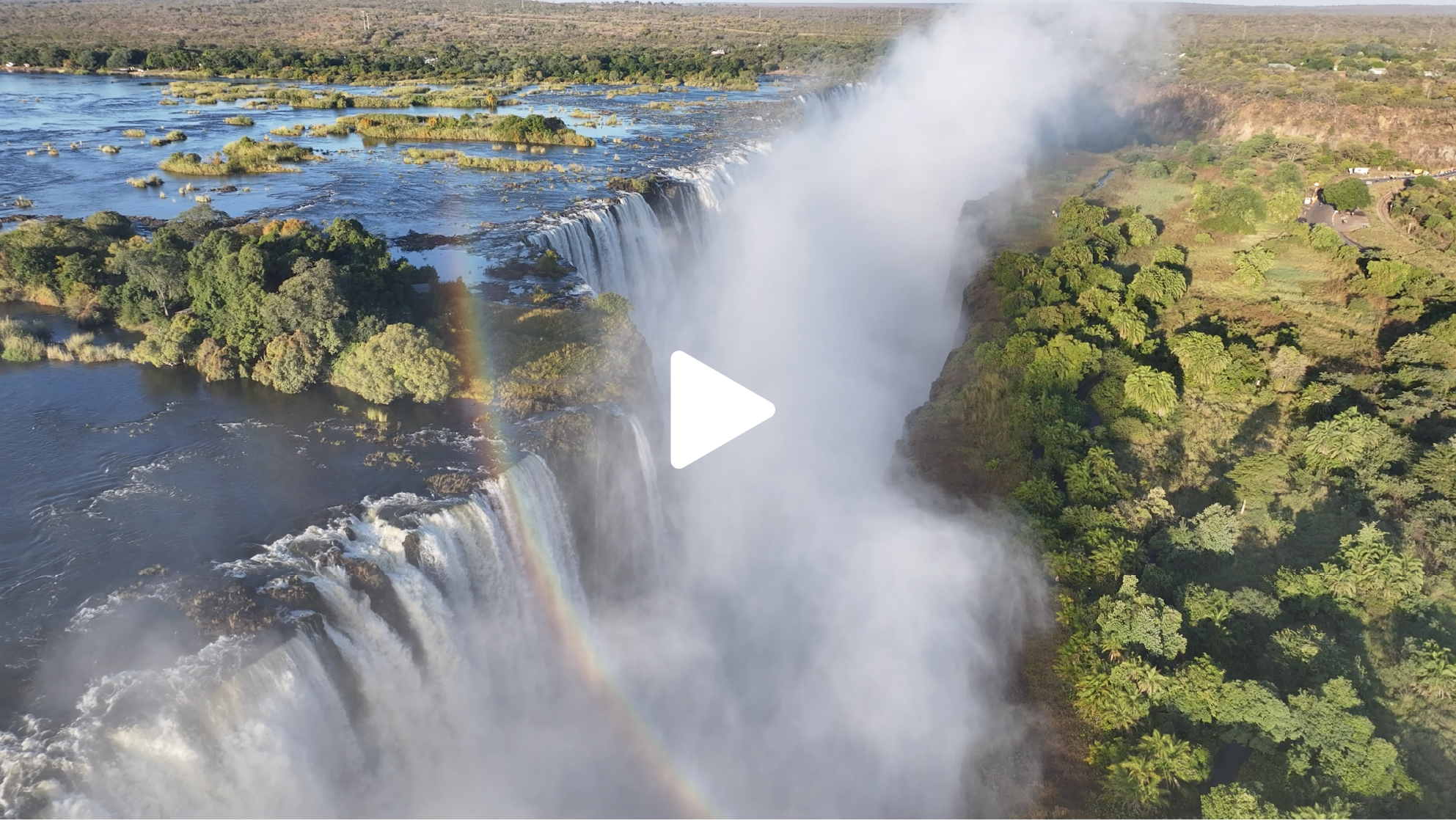
For a considerable distance upstream from the falls, the Zambezi flows over a level sheet of rock in a shallow valley bounded by low sandstone hills. The river’s course is dotted with numerous tree-covered islands, which increase in number as the river approaches the falls.
The falls are formed where the full width of the river plummets in a single vertical drop into a transverse chasm carved along a fracture zone in the rock plateau. The chasm is known as the First Gorge.
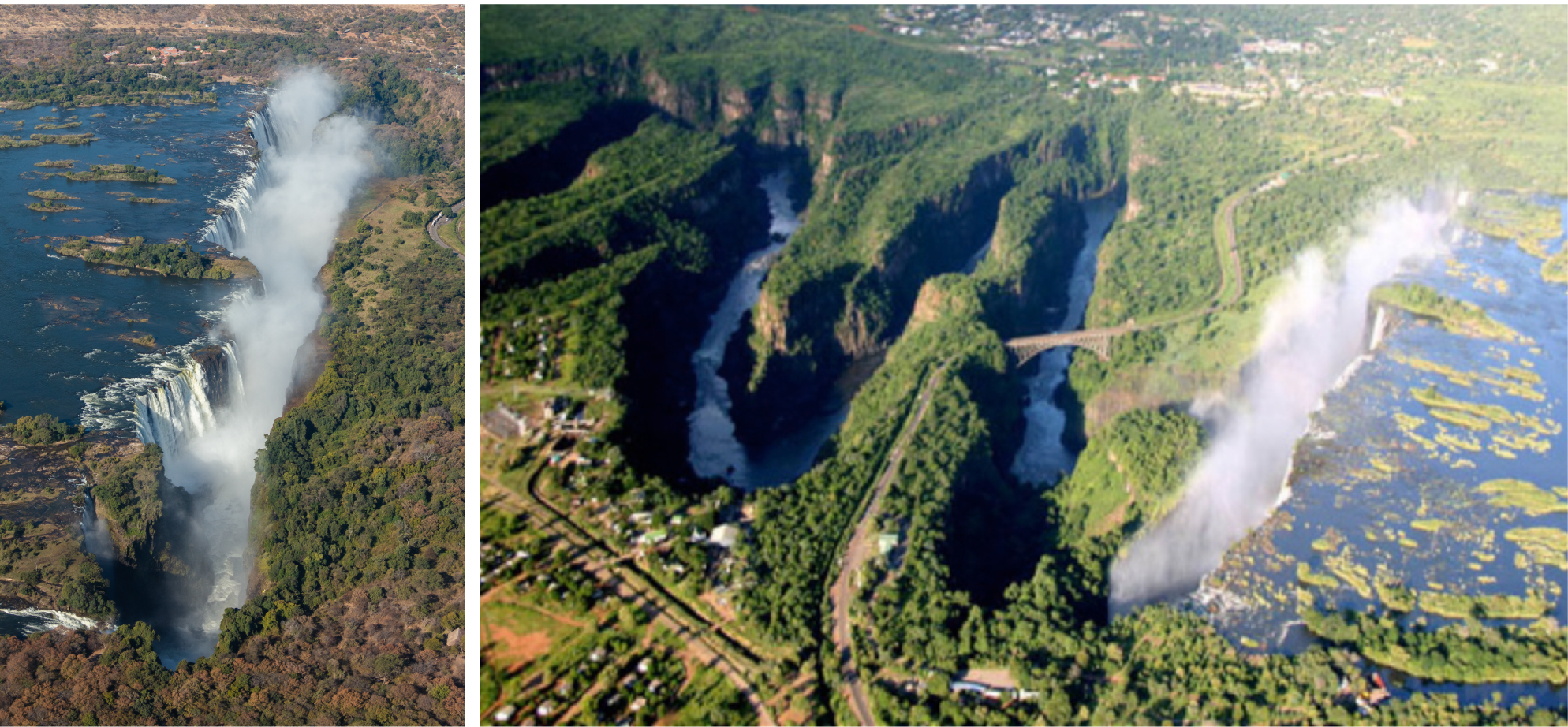
The only outlet from the First Gorge is a 360 ft-wide gap about two-thirds of the way across the width of the falls. The whole volume of the river pours into the Victoria Falls gorges from this narrow cleft. The waters pass through another five gorges that were carved through the millennia by the mighty river.
Two islands are situated on the crest of the falls – Cataract Island near the western bank, and Livingstone Island near the middle. At less than full flood, additional islets divide the curtain of water into separate parallel streams.
The River Zambezi, upstream from the falls, experiences a rainy season from late November to early April, and a dry season the rest of the year. The river’s annual flood season is February to May with a peak in April. The spray from the
falls typically rises to a height of over 1,300 ft, sometimes up to twice as high, and is visible from up to 30 miles away.
At full moon, a “moonbow” can also be seen. The minimum flow, which occurs in November, is around a tenth of the April (flood season) figure; this variation in flow is greater than that of other major waterfalls.
Modern History
In November 1855, David Livingstone was the first European who saw the falls, when he traveled from the upper Zambezi to the mouth of the river between 1852 and 1856. The falls were well known to local tribes, and hunters.
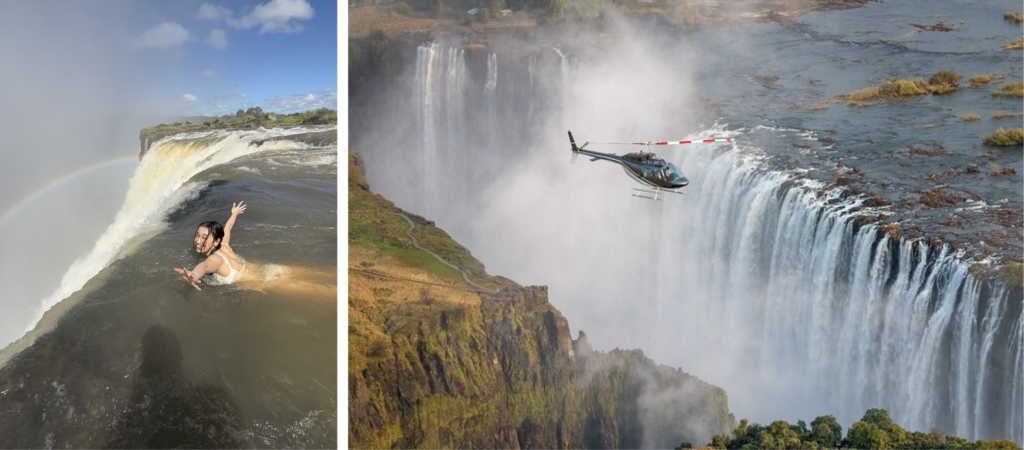
Livingstone had been told about the falls before he reached them from upriver and was paddled across to Livingstone Island in Zambia. In his diary he stated that “Angels must have gazed upon this in flight”. Coining today’s helicopter
flights over the falls as the “Flight of Angels”.
Until the area was opened up by the building of the railway in 1905, the falls were seldom visited by other Europeans.
European settlement of the Victoria Falls area started around 1900 in response to the desire of Cecil John Rhodes to exploit the minerals and other natural resources such as timber forests north-east of the falls, plus ivory and animal skins.
Before 1905, the river was crossed by dugout canoe or a barge towed across with a steel cable. After 1905 the railway offered accessible travel from as far as the Cape in the south and to the Belgian Congo in the north.
In 1904 the Victoria Falls Hotel was opened to accommodate visitors arriving on the new railway. Tourism has seen the development of the region as a center for adventure sports. Activities that gained popularity in the area include whitewater rafting in the gorges, bungee jumping from the bridge, game fishing, horse riding, kayaking, helicopter flights, river cruises, elephant interactions and more.
A famous feature is the naturally formed “Devil’s Pool”, an infinity pool that sits on the lip of the Falls, on Livingstone Island. When the river flow is at a certain level, usually between September and December, a rock barrier forms an eddy with minimal current, allowing adventurous swimmers to splash around in relative safety in front of the point where the water cascades over the falls.
Wildlife
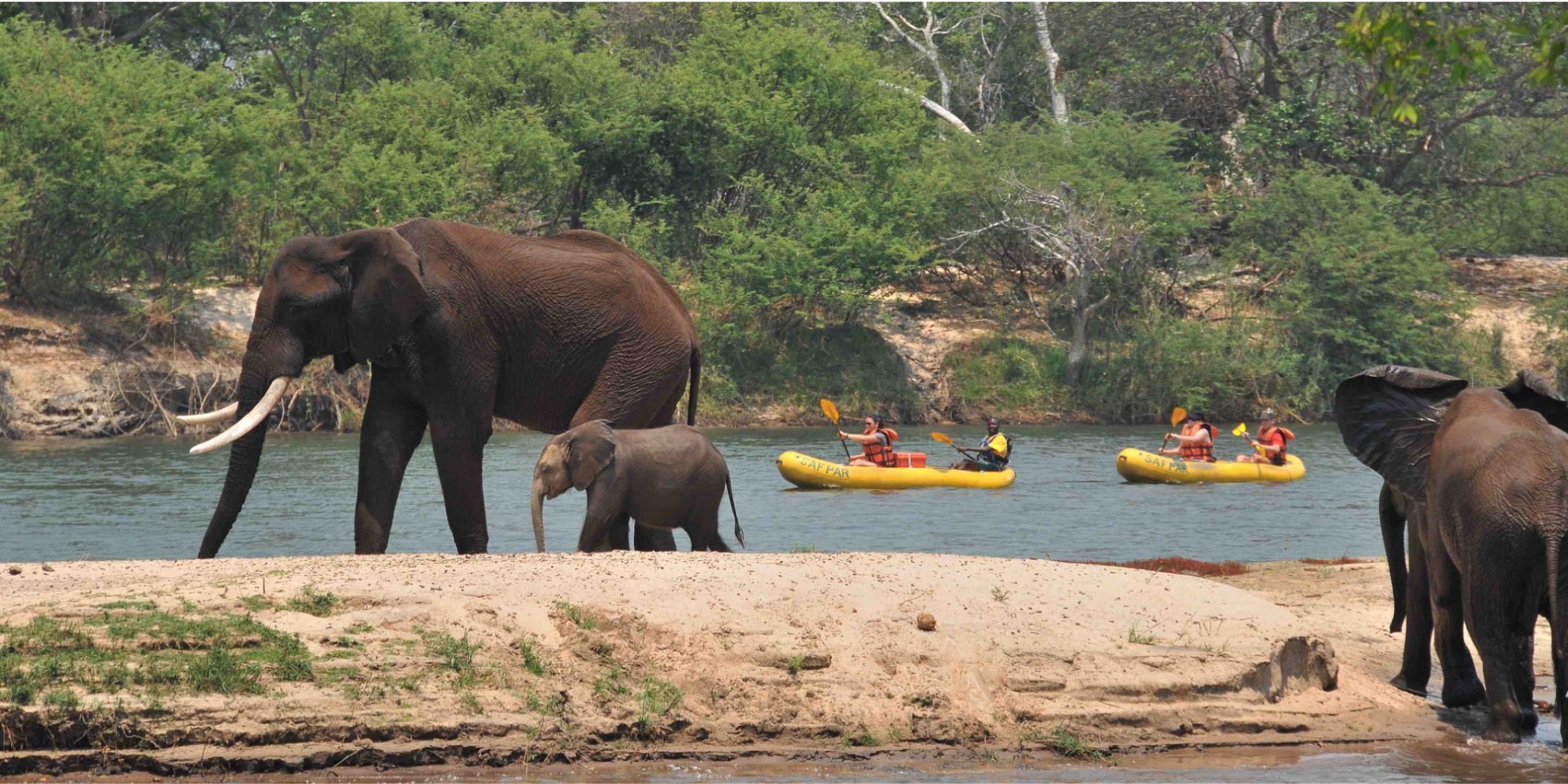
The national parks bordering the river contain abundant wildlife including sizeable populations of elephant, buffalo, giraffe, zebra, and a variety of antelope. Lions, leopards and cheetahs are only occasionally seen.
Vervet monkeys and baboons are common. Southern white rhinoceroses inhabit Mosi-oa-Tunya National Park. Black rhinoceroses roam Victoria Falls Private Game Reserve. The river above the falls contains large populations of hippopotamus and Nile crocodile. Elephant herds are frequently seen crossing the river in the dry season.
Klipspringers, honey badgers, lizards and clawless otters can be glimpsed in the gorges, but the area is mainly known for 35 species of raptors. The Taita falcon, Verreaux’s eagle, peregrine falcon and augur buzzard breed there. Above the falls, herons, fish eagles and numerous kinds of waterfowl are common.
The river is home to 39 species of fish below the falls and 84 species above it. This illustrates the effectiveness of the falls as a dividing barrier between the upper and lower Zambezi.

DID YOU KNOW
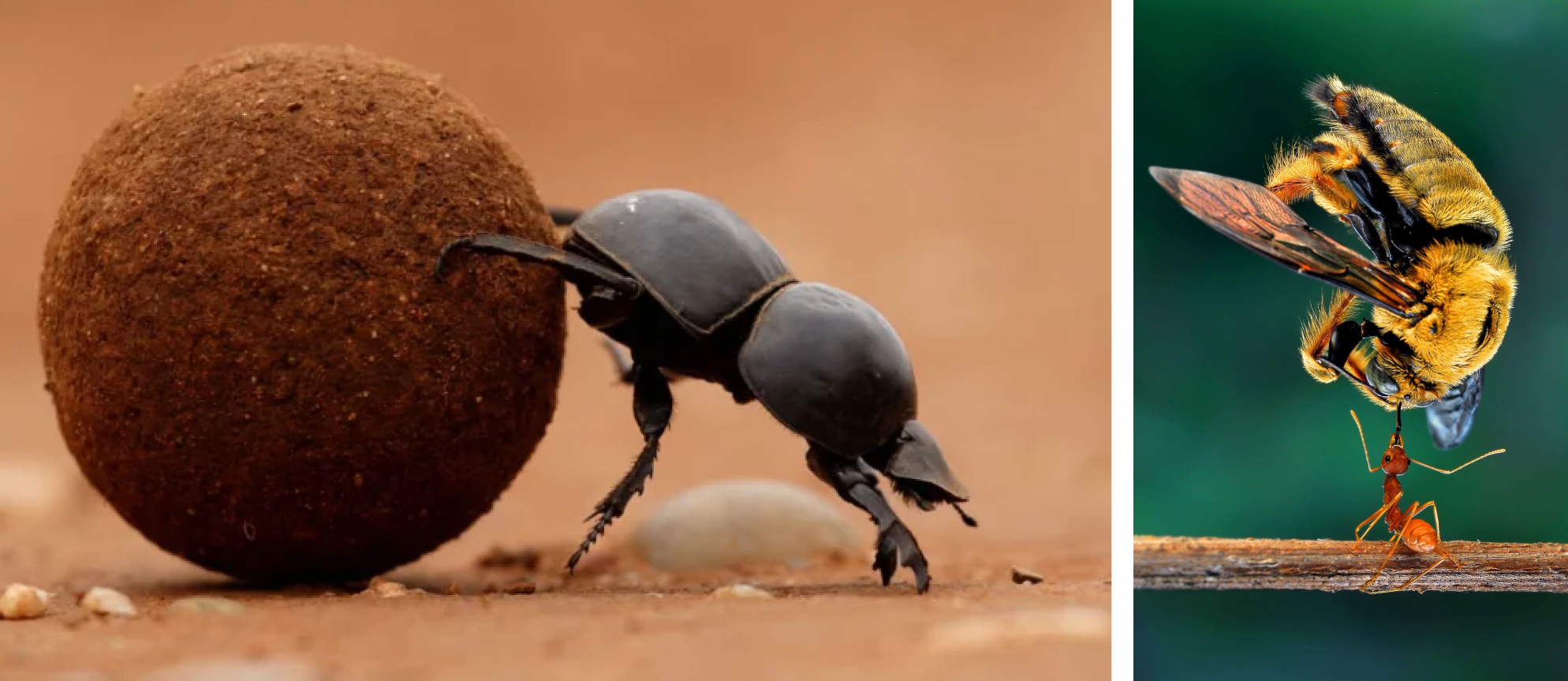
It does not seem as if a weight-lifting contest between a human and an ant is fair, but size for size, it is actually no contest at all. The ant will win hands down, because it can lift and carry up to 50 times its own body weight. If a 175 lb man could achieve this, he would be able to lift and carry 8,800 lbs or three family cars.
A gorilla is eight times stronger than a human, and would be able to lift two tons. An elephant can carry only 25% of its own weight on its back, while a camel can transport 20% of its body weight.
A really strong person is able to pick up objects three times his/her own weight. The world’s weight-lifting champion is the rhinoceros beetle, an impressive insect that can grow to a length of 18 inches. It can easily be regarded as the world’s strongest living creature, because it can carry 850 times its own weight!